Angelo
Multi-agent coordination framework for Cursor and Claude Code. Four MCP servers — coordinator, memory, memory-artifacts, and zettelkasten — expose task-graph orchestration, persistent knowledge management, DVC/S3 experiment artifacts, and multi-source literature-review tools over stdio.
Where to go
-
Learn angelo by setting up a project and running it for the first time.
-
The three pillars — coordinator, memory, and zettelkasten — explained, with the decision record mined from the memory graph.
-
Task-focused recipes: install, update, use the dashboards, run experiments, build a matrix, and troubleshoot.
-
Auto-generated MCP tool reference and Python API docs.
How the pieces fit together
Angelo is four MCP servers over stdio plus an install CLI, sharing two file-backed knowledge stores in your repo. The coordinator orchestrates work, records outcomes to memory, and drives grounded extraction straight into the zettelkasten. Memory can optionally be backed by memory-artifacts for large files and experiments on a remote. A separate optional package — stream — feeds the zettelkasten from a continuous document source; it sits alongside this core picture rather than inside it.
coordinator, memory, and zettelkasten. Dashed = optional: memory-artifacts (large files & experiments on a DVC/S3 remote). All state is plain markdown + YAML in .memory/ and .zettelkasten/, committed to git; caches under .angelo/ are disposable.Three design commitments hold it together:
- Files are the source of truth.
.memory/and.zettelkasten/are markdown - YAML, committed to git, so your knowledge travels with the repo and its
history. Caches under
.angelo/are disposable and rebuilt on demand. - Lean MCP surface. Cursor caps the total number of tools across servers, so each server keeps a deliberately small, dispatch-style tool set.
- Two dashboards, one per store. Each knowledge store ships a read-mostly web
UI, launched from its own MCP server: the memory dashboard
(
angelo-dashboard) over.memory/, and the zettelkasten dashboard (angelo-zk-dashboard) over.zettelkasten/.
Design choices recorded during development are promoted into browsable architecture decision records, generated from the memory graph.
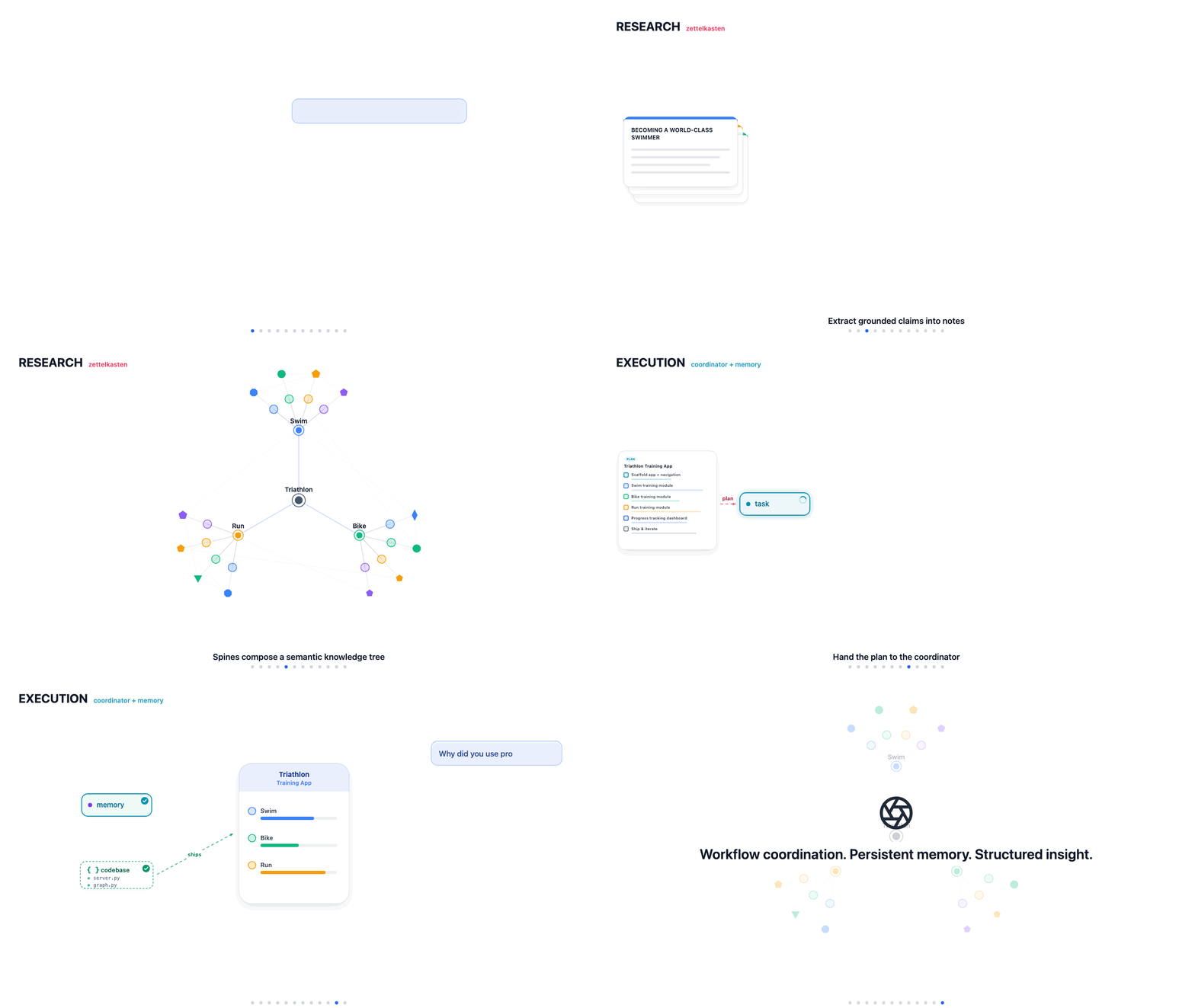
The three pillars
-
Task-graph orchestration: scope a task, design a DAG of agents, execute it in waves of subagents. Lightweight by design — no runtime, no server, riding the editor's native subagent spawning. Console script
angelo-coordinator. -
Persistent knowledge across sessions: a research tree, a skills library, a live code graph, and session continuity — plus a toggleable experiments & artifacts companion (
memory-artifacts). Console scriptangelo-memory. -
Multi-source literature-review knowledge graph: read a whole corpus into grounded notes, then organize them into spines and comparison matrices without forking the truth. Console script
angelo-zettelkasten.
Project layout
See each package's README for module-level detail: