Why angelo, not a framework
Most multi-agent frameworks — LangGraph, CrewAI, AutoGen, and friends — ship a runtime: a Python process you host, an execution engine that owns the control loop, usually a state store, and often a server and a UI. You write your agents inside their abstractions and hand them the keys to run the show.
Angelo's coordinator ships none of that. It is a protocol plus a small MCP tool set, and it rides the subagent spawning your editor already has.
Where the agents actually run
The load-bearing idea: angelo does not run agents — your editor does.
Cursor and Claude Code can already spawn subagents (Cursor's Task tool; Claude Code's subagents). Those subagents are full agent sessions with tools, context, and a model — the exact thing a framework spends most of its code reimplementing. Angelo leans on them instead:
- The coordinator designs a task DAG and asks for your approval.
- For each ready task it takes a write lease and asks the host agent to spawn a subagent (the same primitive you'd use by hand).
- The subagent does the work; the coordinator records the result, advances the wave, and appends fix cycles when a check fails.
So the "engine" is the editor's own agent loop. Angelo is the thin layer that turns a one-shot "spawn a subagent" button into a reviewable, resumable graph.
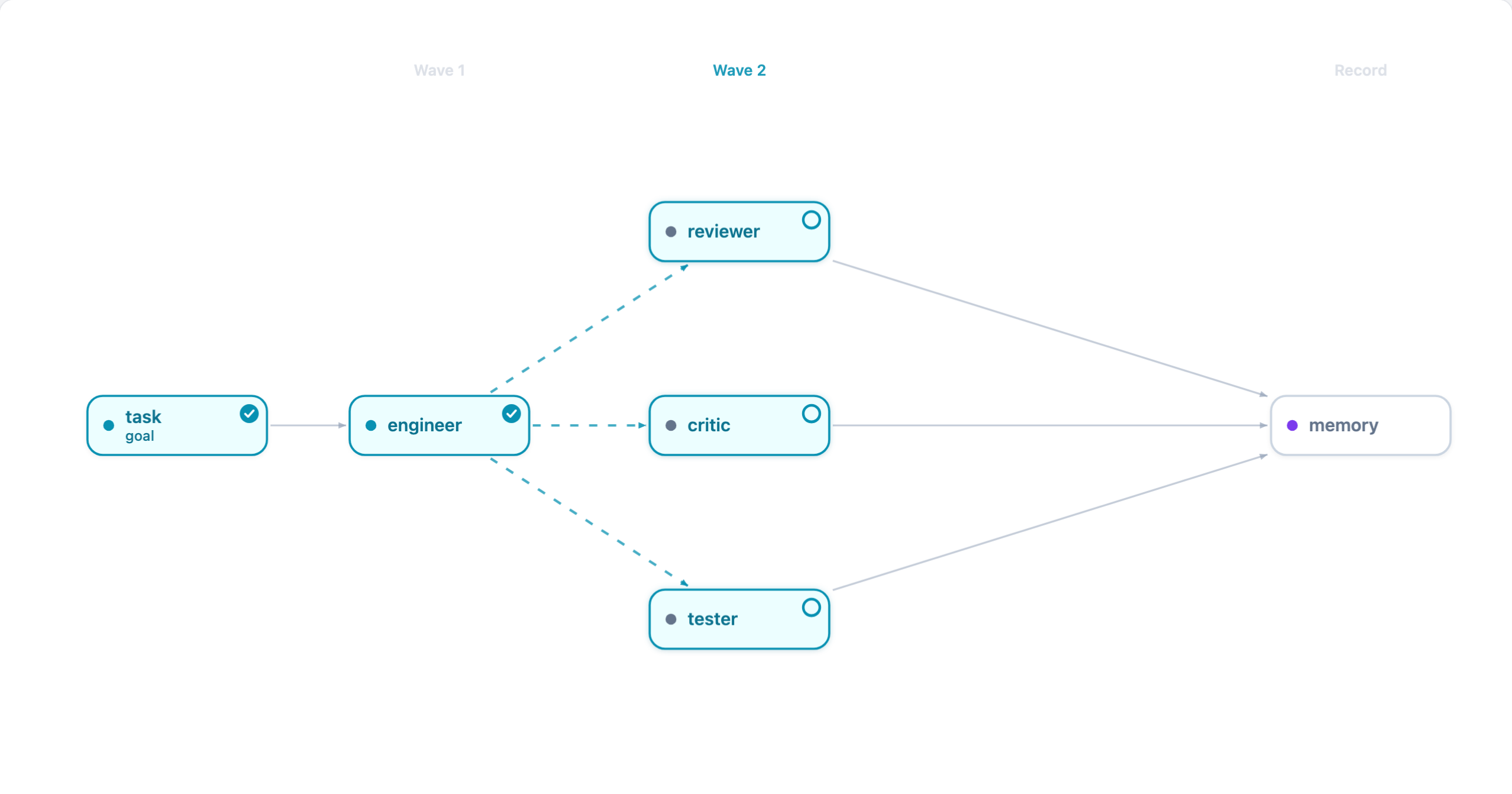
The coordinator only tracks the graph: each node is a subagent the editor spawns. Here Wave 2's checkers run in parallel after the engineer, with the memory node waiting to record last.
What that buys you
| Typical framework | Angelo coordinator | |
|---|---|---|
| Runtime | A process/engine you host and keep alive | None — it's MCP tools over stdio |
| Where agents run | Inside the framework's executor | The editor's native subagent spawner |
| State | A database or in-memory store you manage | Plain files in .memory/ + coordinator state, committed to git |
| Install footprint | The framework + its transitive deps | A pip package exposing MCP servers |
| Model access | You wire up API keys and providers | Whatever your editor already uses |
| Observability | Framework-specific tracing | The memory dashboard, reading the same files |
| Lock-in | Agents written to the framework's API | Agents are just prompts + personas in agents.yaml |
The practical upshot: there is nothing extra to deploy, no second place for secrets, and no divergence between "the agent in my editor" and "the agent in the pipeline" — they are the same runtime.
Just enough orchestration
Being lightweight doesn't mean being naïve. The coordinator adds exactly the coordination a shared-workspace, multi-agent run needs, and no more:
- Waves + a DAG. Tasks declare dependencies; the coordinator runs each unblocked wave, waits for all of it, then decides what's next.
- Path-scoped write leases. Implementers with disjoint
writesrun in parallel; only overlapping scopes serialize. That is the entire concurrency model — no global lock, no scheduler. - Bounded, on-graph fixes. A failed review appends an
[engineer, reviewer]cycle up to a rigor-set cap, then escalates to you. Corrections never happen off-graph, so the dashboard always reflects reality. - Resumability. Because the graph and its results are files, a run whose chat closed can be adopted and continued rather than restarted.
When you'd still want a heavier framework
Angelo is aimed at coding and research work driven from an editor, where the host already provides capable agents. If you need to run agents headless on a server with no editor in the loop, orchestrate long-lived autonomous services, or express control flow far richer than a DAG of waves, a full framework earns its weight. Angelo trades that generality for near-zero setup and complete transparency in the environment where you actually work.
Related
Semantically related entries from the memory graph.