Experiments and AWS
How angelo makes an experiment reproducible on a machine that never touched the original run — and how a second machine reruns it without ever talking to the first one directly.
- Package overview:
memory/README.md - Behavioral contract:
.cursor/rules/memory.mdc - Do the task: Run experiments
- Tool reference: MCP tools → memory-artifacts
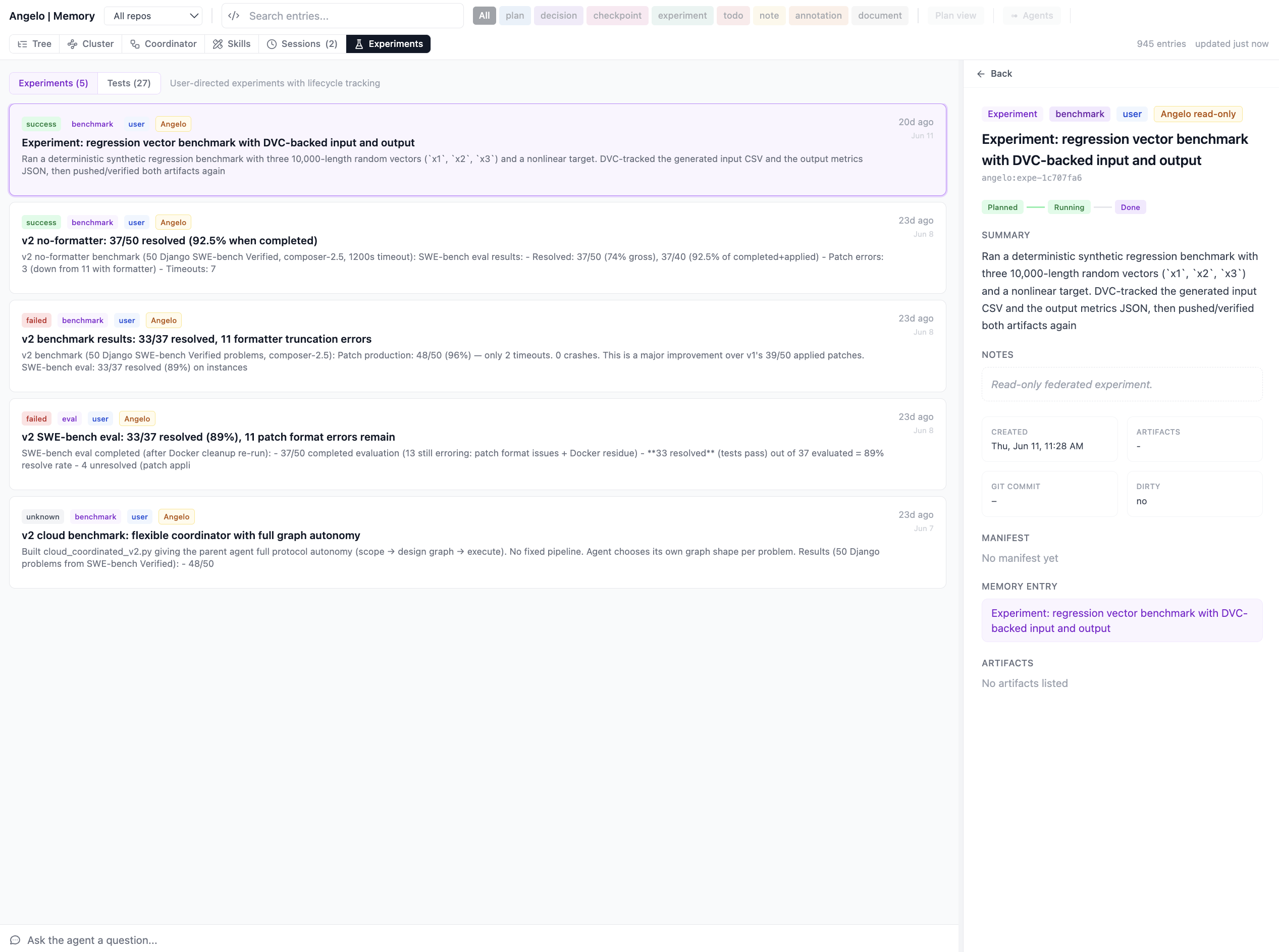
The Experiments tab — provenance manifests joined with their memory entries (with a pass/fail status and a separate Tests sub-tab).
Why it exists
A bare result file is not an experiment. To trust an output you need to know the code that produced it, the inputs it consumed, and the command that wired them together — and you need that record to survive long after the original working tree is gone. Angelo also runs across more than one machine: a laptop where work is scoped and a compute box (typically AWS) that has the cycles and the credentials. Those two machines have no direct link — no SSH session, no RPC, no always-on socket between them.
Why split provenance across three layers
Code, large bytes, and the recipe that joins them have different lifecycles. Code is small and belongs in git history. Artifacts are large, regenerable, and content-addressable — they belong in object storage, not git. The recipe (which commit, which command, which input hashes) is a tiny immutable record that pins the other two together. Keeping each in the store that fits it is what makes a run replayable on a fresh machine instead of merely archived.
How it works
The three-layer model
Every experiment is recorded as three cooperating layers:
- Git commit — code,
.dvcpointer files (a path plus its contentmd5and size), memory entries, and the manifest itself. This is the small, versioned, diff-able layer. A manifest capturesgit_commit = HEADat run time (seebuild_experiment_manifestinmemory/artifacts.py). - DVC / S3 content-addressed artifacts — the actual bytes. DVC stores each
file under its
md5in the S3 bucket configured as the DVC remote; git keeps only the pointer. Because storage is keyed by content hash, identical bytes are stored once and any copy can be integrity-checked against its hash. - Manifest — the provenance record at
.memory/artifacts/manifests/<id>.yaml: schema version, id,git_commit,command,cwd, a dirty-tree flag/diff, a redacted environment summary, the artifact list (each with itsmd5), anartifact_state(local_only → queued → remote_verified, orfailed), and the remote it was pushed to. Secret-looking keys are scrubbed before the manifest is committed.
A rerun never needs the original machine: git_commit + command + cwd +
content-hashed inputs is a complete, replayable recipe. The manifest even
records each input's md5 so an input can be materialized from DVC even when
its pointer file was committed after the manifest's git_commit — a real lag,
since pointers are usually committed just after a run.
The cloud-rerun architecture
The two machines collaborate through shared storage only. The S3 bucket carries
both the artifact bytes (DVC cache) and a job queue under
<DVC remote>/jobs — small JSON files moved between pending/, running/,
done/, and failed/ prefixes, with logs under jobs/logs/ (see
memory/jobs.py). The queue base is resolved from ANGELO_JOBS_URI or, by
default, the DVC remote URL plus /jobs.
git pull.Cloud mode (experiment(action='rerun', where='cloud')) resolves the target
manifest, builds a job spec, and enqueues it. The angelo-runner daemon
(memory/runner.py) polls the queue on the AWS box, claims the oldest pending
job (claim_next atomically moves it to running/), git pulls so the
referenced manifest is local, then calls rerun_experiment. That:
- creates a git-worktree sandbox detached at the original commit,
- reconstructs and
dvc pulls inputs by content hash, - runs the manifest command in the recorded
cwd, - copies outputs into a per-run folder
(
.memory/artifacts/experiments/<family>/runs/<stamp>/), DVC-adds and pushes them, - writes a new dated run manifest carrying
rerun_of,executor, and a replication check.
Results flow home the same decoupled way they came: artifact bytes via S3, and
the new run manifest via git commit + git push to the shared remote, so
every other machine sees the run after a git pull. The runner streams its log
back to jobs/logs/, so the originating machine can poll progress with
experiment(action='get_job', job_id) without any direct connection.
The replication check
The rerun compares each regenerated output's md5 against the original output's
md5 (read from the pointer as it stood at the original commit) and grades
the run:
- exact — every output hash matches; bit-for-bit reproduction.
- divergent — at least one output differs (or is missing). Often legitimate: if the original run was dirty (uncommitted changes), the sandbox reran the committed code, so a caveat is recorded explaining the gap.
- unknown — outputs were produced but no original hash was available to compare against.
What's available
| Concern | Where it lives |
|---|---|
| Manifest build / read / verify, sandbox rerun, replication | memory/artifacts.py |
| S3 job queue (state prefixes, claim/heartbeat/logs) | memory/jobs.py |
angelo-runner daemon (poll → rerun → publish) |
memory/runner.py |
MCP tools: artifact, pipeline, experiment |
memory/artifact_tools.py |
These tools live in the separate memory-artifacts MCP server, so the block
can be toggled independently of the core memory server. Using the remote
requires the [artifacts] extra and a configured S3 DVC remote
(artifact(action='configure_remote')). For the step-by-step task — capturing a
manifest, backing up a file, kicking off a rerun — see
Run experiments.
Design notes
The decisions behind this, drawn as a slice of the memory tree.
- P Plan: cloud-first experiment rerun with S3 job queue and AWS runneractive
Confirmed plan for one-click experiment reruns. - D Implemented grounded-extraction bundle via a generic coordinator capability-contribution seamactive
A grounded-extraction run applies a fixedextractor -> scribe -> auditor(+ trailingmemory) pipeline to N sources, parameterized by one named schema (a rubric).
- R Angelo
- P zettelkastenactive
- P Phase: Grounded Extraction Pipeline + Reusable Schemas (coordinator capability)active
- P Experiment Infrastructure: Memory Hardening + DVC Artifactsactive
- P Phase 2: DVC + S3 Artifact System with Experiment Manifestsactive
- P Phase 2 infrastructure plan: guaranteed remote artifact state before DVC pipelinesactive
- P Plan: cloud-first experiment rerun with S3 job queue and AWS runneractive
- C Checkpoint: cloud rerun infrastructure built and tested
- P Plan: cloud-first experiment rerun with S3 job queue and AWS runneractive
- P Phase 2 infrastructure plan: guaranteed remote artifact state before DVC pipelinesactive
- P Phase 2: DVC + S3 Artifact System with Experiment Manifestsactive
- P zettelkastenactive
Related
Semantically related entries from the memory graph.